
By Tryphtin Scott, MA, LPCC
In Chapter 11 of C. S. Lewis’s The Great Divorce, Pam comes to the edge of heaven looking for Michael. When her brother Reginald tells her that she must begin to want God, she is willing to try religion if it gets her to her son. Reginald hears the bargain. He isn’t asking her to begin by loving God more than Michael. He’s asking whether she can begin to want God for his own sake at all.

Later, the narrator asks George MacDonald if there is any hope for her. MacDonald has heard the same conversation and doesn’t soften what he heard. Yet he can still see something there:
But there’s still a wee spark of something that’s not just herself in it. That might be blown into a flame.
That is a narrower hope than saying Pam’s devotion is already holy, and a greater one than saying it must all be thrown away. Something in Pam’s affection is really for Michael. To want him for herself and to love him are not quite the same thing, though both can be present in the same act. What would divine love make of the part that is truly for him?
What the spark can become
MacDonald says natural affection offers a better beginning in one respect and a greater danger in another. It can lead toward eternal love more readily than appetite can. But it resembles that love closely enough to be mistaken for it. He compares the mistake to taking brass for gold. Brass is not worthless; it’s close enough in appearance to fool you in a way clay is unlikely to.
That distinction gives the spark its significance. If there were nothing good in Pam’s love, there would be nothing there to transform. If the good already in it were sufficient, there would be no need for transformation. Nor would simply making the feeling stronger help. The possessiveness would grow stronger too. What has to change is the end her love serves. As long as God is useful to Pam only because he can give her Michael, she hasn’t begun to want the one who could teach her to love Michael differently.
Dante’s desire at the end of the ascent
Dante gives this transformation a destination. In Purgatorio XVII, Virgil explains that love can go wrong in its object or in the force with which it pursues a good. A good object does not guarantee a good way of loving it. But the poem also shows why correcting an error is only part of the journey. Dante has to become capable of a love he cannot yet imagine.
Beatrice is part of how he gets there. She is someone Dante loves, and she also guides and corrects him. The poem does not make her irrelevant once she has done her work. It shows that the good he encountered in her was never exhausted by what he could receive from her. His love for a particular person could carry him further than the desire with which he began.
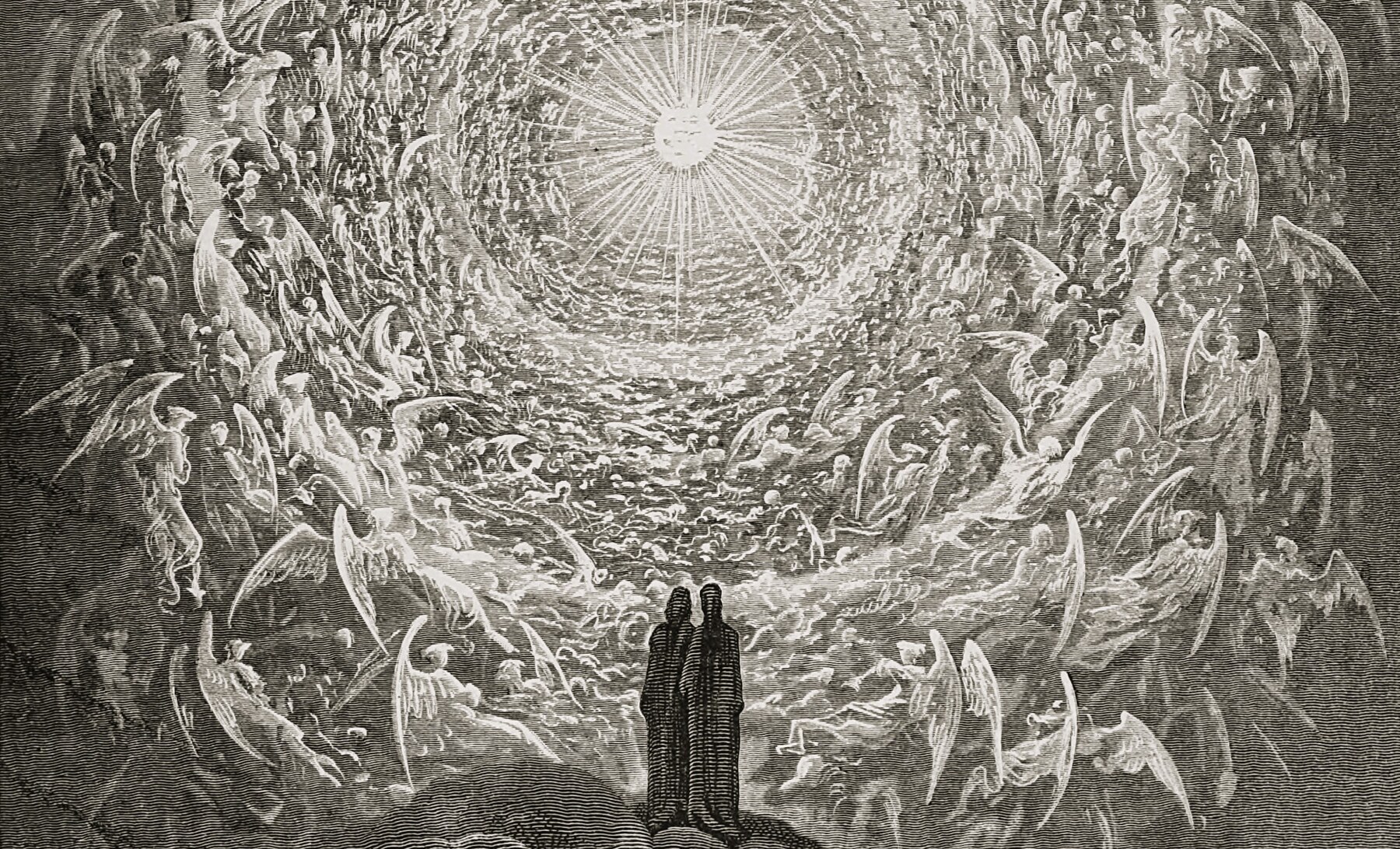
In the final canto of Paradiso, Dante sees a human likeness within the divine circles, an image of Christ’s humanity within divine life. He cannot work out how the two belong together. He receives in a flash what he could not reach by reasoning it through. The last thing Dante tells us is what has happened to his desire and will: they are already turning in harmony, moved by the same Love that moves the sun and the other stars. His desire is still his. It is no longer trying to move on its own.
What attachment can help us understand
In attachment theory, a secure base is a relationship that gives a person enough confidence to explore rather than devote all his attention to securing the bond. Cyd and Geoff Holsclaw bring that insight into conversation with Christian formation in Landscapes of the Soul. How a person has learned to seek or protect connection can shape what it feels like to trust God. For Pam, surrender looks like giving up the only thing that still makes sense to her. Attachment theory helps explain why a demand for proof can feel more possible than trust.
But the end Lewis and Dante are after goes beyond feeling secure enough to let go. In Christian terms, glorification is the completion of the work by which God conforms us to Christ. Paul describes that change in 2 Corinthians 3:18 and Romans 8:29–30: we are changed as we behold the Lord, and the end of that change is glory. A trustworthy bond can help us understand why we might risk being changed. Union with God is what gives that change its direction and its end.
Lewis leaves Pam before the change. Dante lets us see its completion. In Pam, the spark is the small part of an affection already capable of turning beyond herself. In Dante, human desire has become capable of being moved by the Love it sought. There is no reason to despise the spark for not being a flame. There is every reason not to ask it to give the light only a flame can give.
Sources and further reading
C. S. Lewis, The Great Divorce, Chapter 11. Dante Alighieri, Purgatorio XVII, 91–105, and Paradiso XXXIII, 127–145.
Amber Dunai, “The Process of Salvation in Pearl and The Great Divorce”; John Bowlby, A Secure Base; Cyd and Geoff Holsclaw, Landscapes of the Soul.